Grasshopper sparrow stewardship on
Clearwater Farm
Grazing strategies to create nesting opportunities on a 120-acre beef cattle farm near Hanover, Ontario, Canada
Grasshopper sparrows are migratory songbirds that nest in grasslands. They build nests directly on the ground, making eggs and young vulnerable to trampling and exposure to predators when livestock grazing overlaps with nesting. This species, which is listed as Special Concern, is uncommon and its population is declining across Ontario.
Most of the grassland in the province is agricultural, linking the fate of Ontario's grasshopper sparrows to the amount and management of hayfields and pastures.
In 2022, Bird Ecology and Conservation Ontario began a research project to assess the impact of stewardship actions intended to benefit nesting grasshopper sparrows.

About half of the pasture at Clearwater Farm is hilly with sandy soil and relatively sparse vegetation, providing nesting habitat for grasshopper sparrows. Although they frequently nest in the same fields as Savannah sparrows and sometimes with bobolinks and eastern meadowlarks, habitat preferences differ. Because grasshopper sparrows typically nest in shorter and sparser vegetation compared to bobolinks, they are more tolerant of some of the impacts of grazing, providing numerous opportunities for stewardship in pastures to increase nest success. The approximate locations of some of the grasshopper sparrow nests located on the farm are shown below. These nests were active at different times during the season.
Grasshopper sparrow nesting habitat
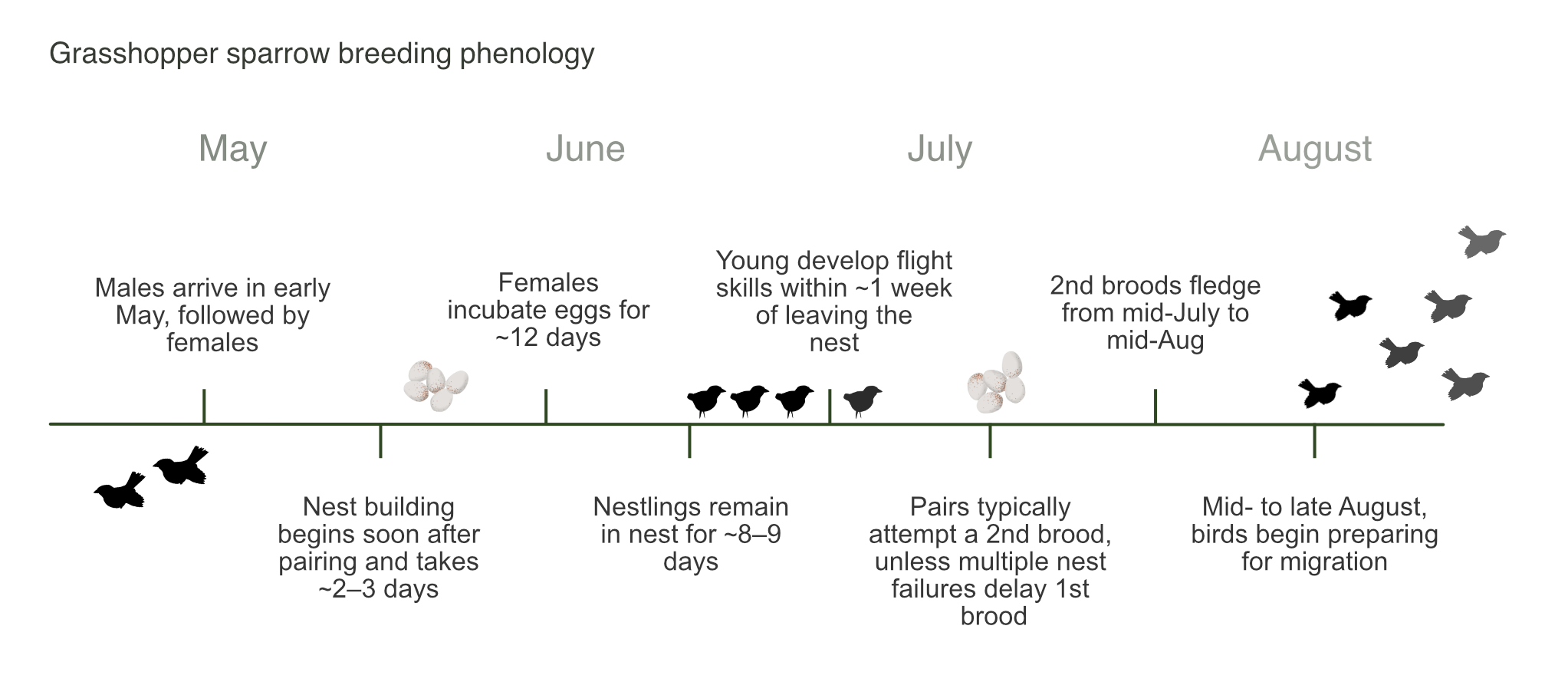
Grasshopper sparrows—named for their quiet, buzzy, insect-like song— begin arriving on their breeding grounds in Ontario in early May.
The males arrive first and begin singing and displaying to attract females and establish territory boundaries. Males and females look alike and the species is typically monogamous.
Grasshopper sparrows require about 35 days to raise young: 3 days to build a nest, 25 days from egg laying to fledging, and 7 days until young can fly. Successful pairs typically attempt to raise a second brood.
Nest failure due to predation is common. Pairs renest repeatedly after nest failure throughout the nesting season.
Timing of nesting varies, but late May through mid-July is the most critical period during which the majority of nests are active.
We began observations in each grasshopper sparrow nesting territory in mid-May, visiting twice per week for the duration of the nesting season to determine the location and outcome of nesting attempts.
conducting behavioural observations.
Photo by Kaila Ritchie
Conducting behavioural observations of grasshopper sparrows requires extreme patience and focus. Females are particularly cryptic and rarely observed, but are key to determining nesting status.
At the beginning of the nesting season, we recorded locations of each male across multiple visits to determine territorial boundaries. Although males defend their nesting areas against other males, territories often overlap.
This image shows the approximate boundaries of 2 grasshopper sparrow nesting territories.
conducting nest monitoring
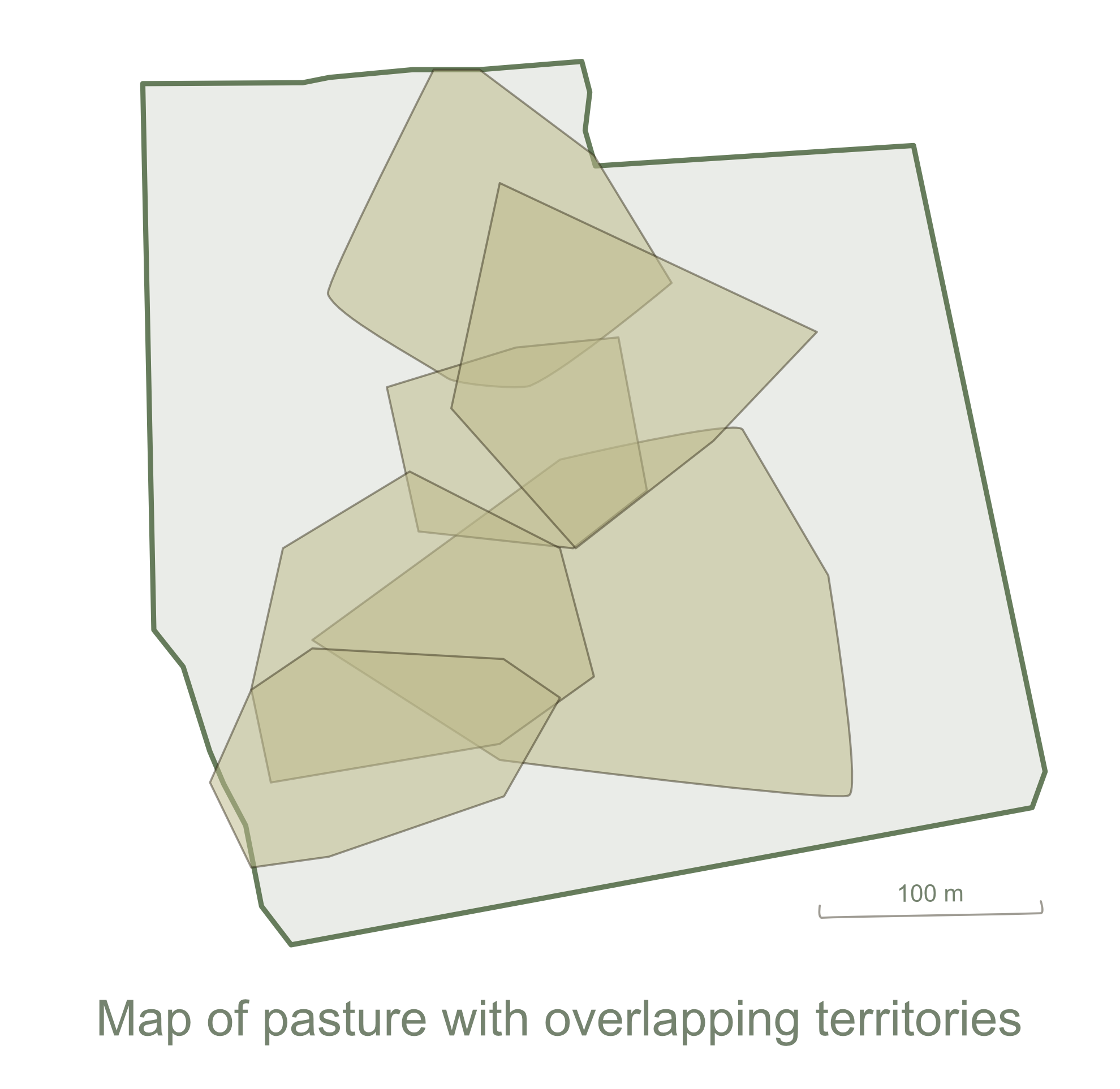
We located and monitored 6 grasshopper sparrow nesting territories throughout the breeding season in a 32-acre area of the pasture. Average territory size was ~3.5 acres.
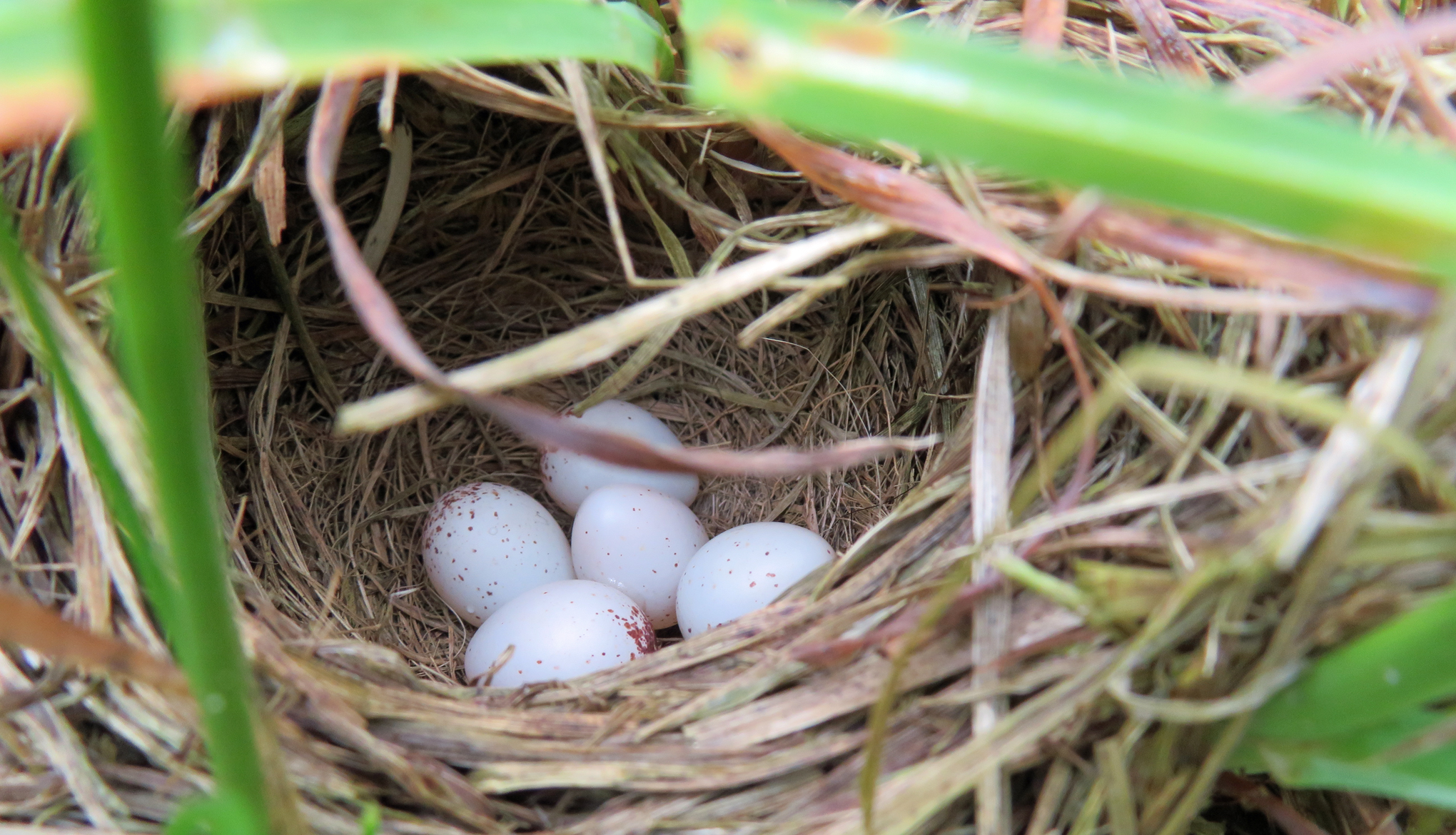
In mid-May, shortly after pairing, females begin building nests. Nests are constructed on the ground in 2–3 days. Once eggs are laid, the female incubates the clutch for ~12 days.
Late May is also when 39 cattle, 30 calves, and 1 horse began grazing at Clearwater Farm. The pasture was subdivided and each section was grazed for a few days to a week, sometimes longer for larger sections, more than once during the nesting season. Cattle can have negative impacts on ground-nesting birds by inadvertently trampling nests or removing vegetation that conceals nests from predators and provides protection from the elements. Rotational grazing at Clearwater Farm provided numerous opportunities to implement stewardship to reduce the negative impacts of grazing and increase chances for successful nesting.

By early June, some grasshopper sparrow nests have hatched. Both parents feed young a diet of invertebrates—including grasshoppers—and nestlings develop quickly, leaving the nest just 9 days after hatching. These nestlings are 5 days old.
Young remain vulnerable after leaving the nest, requiring another 7 days before they can fly. Pairs continue to care for their young for several weeks after fledging.
By mid-July, the most vulnerable period for nesting grasshopper sparrows is typically over as more nests reach completion and young develop flight skills. However, because grasshopper sparrows will attempt a second brood, they frequently nest into late July and even August. Balancing farm management and stewardship can help provide these grassland birds with adequate time and space to raise young.
Two stewardship practices, delayed grazing and an extended rest period, were implemented on Clearwater Farm to reduce the risk of nests being trampled or otherwise negatively impacted by grazing.
Delayed grazing refers to delaying grazing until after the peak breeding season (i.e., after mid-July) to create a nesting refuge where birds can fledge young.

Extended rest refers to lengthened periods of rest between grazing occasions (i.e., at least 42 days) to provide time for nesting. If vegetation remains suitable, grasshopper sparrows will likely stay and renest even if early nesting attempts fail. This strategy can work well for grasshopper sparrows because they are relatively tolerant of changes in vegetation due to grazing, unlike bobolinks, which typically abandon territories after fields are grazed.

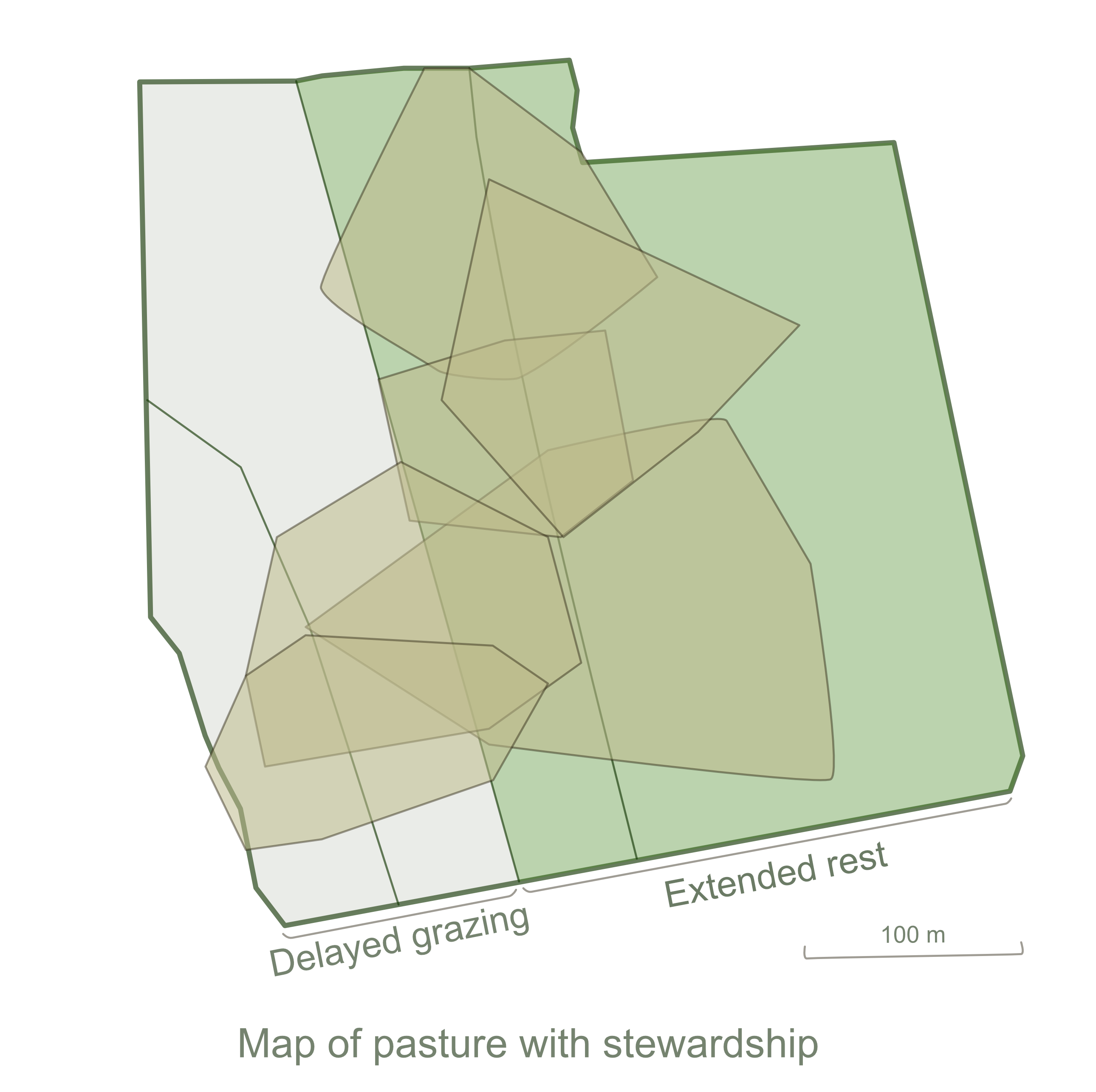

In the 2 fields that were grazed in early May, then rested for about 8 weeks, the grasshopper sparrows had ample time to renest after early-season failures. Each territory was able to fledge 1 brood.
In the 2 fields where grazing was delayed—which created undisturbed habitat for much of the breeding season—the birds had enough time to fledge their first brood and attempt a second brood. One territory was able to fledge 2 broods (their second nest was in the adjacent field that was grazed early, then rested for ~8 weeks).
By mid-August, the breeding season starts to wrap up and grasshopper sparrows begin preparing for fall migration. Little is known about migration and the non-breeding grounds of Ontario's grasshopper sparrows, but they likely winter in the southeastern USA, Caribbean, or Central America.

on the final field visit of the season
Farmers who manage agricultural grassland are integral to grassland bird conservation. Stewardship actions aim to balance farm management with providing at-risk grassland bird species a better chance of raising young. On Clearwater Farm, stewardship actions increased nesting opportunities, allowing all 6 monitored grasshopper sparrow territories to fledge at least 1 brood. Although stewardship has demonstrated positive results, more research is needed to find compatibility between farm practices and grasshopper sparrow breeding success.
to a new field at Clearwater Farm